
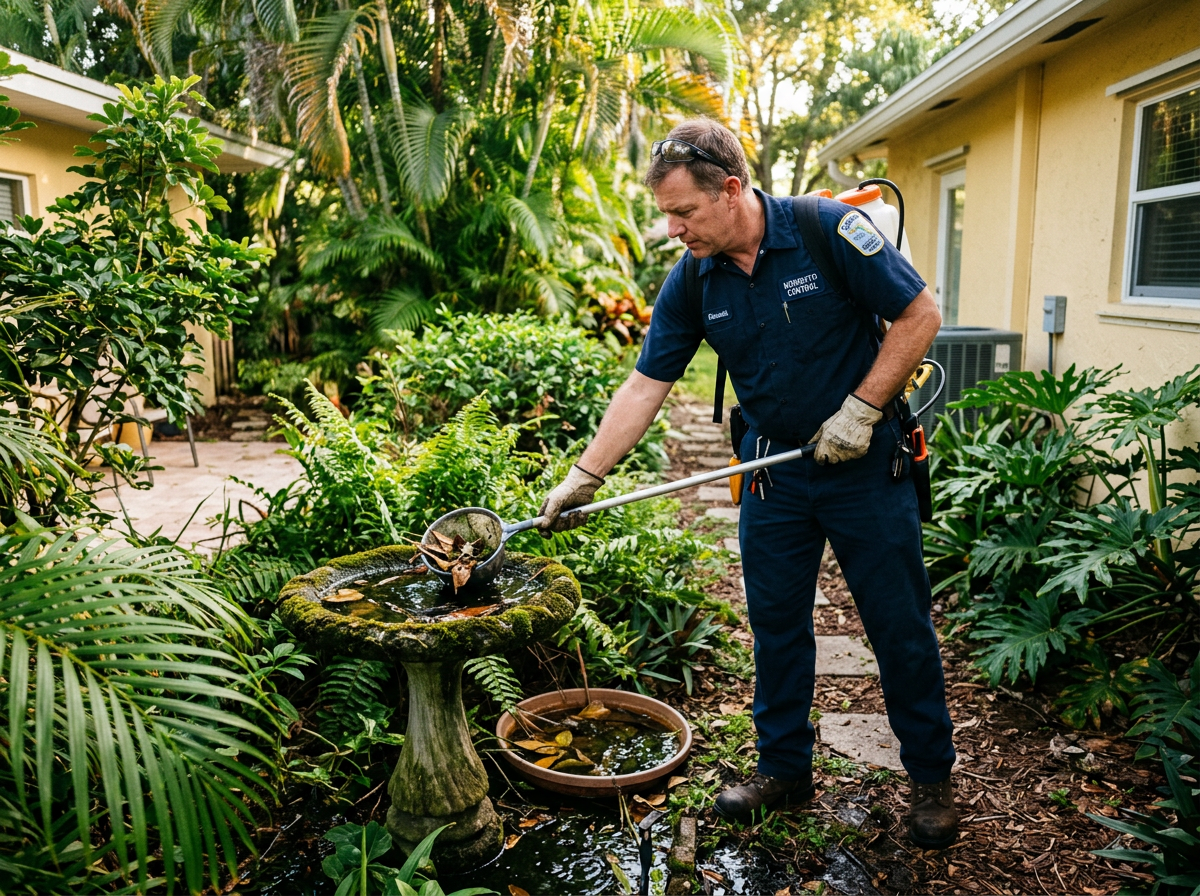
In Brooksville the daily cycle begins with container breeders that need only a bottle cap of water. Bromeliads, plant saucers, clogged gutters, rain barrels and boat covers sitting within a few metres of the house refill every afternoon when storms pass through. Technicians walk the entire lot, tipping, flushing or removing each container rather than spraying open lawn where adults do not rest.
Work focuses on the shaded, protected spots where larvae actually develop. Gutters are cleared of debris so water flows to downspouts; tarps and covers are lifted and dried; saucers under potted plants are emptied or drilled for drainage. When water cannot be removed, a targeted larvicide is placed in the remaining pockets. The same inspection catches the small pockets behind air-conditioner drip lines and in old wheelbarrows left behind sheds.
Standing Water and Breeding Site Reduction Near You — Choose Your City
Every city below has its own local Standing Water and Breeding Site Reduction page with coverage details.
Polk County
Lee County
Citrus
Brevard
Polk
Putnam County
Indian River County
Alachua
Lake
Sumter County
Sumter
Hamilton County
Levy
Bradford County
Hillsborough County
Lake County
Flagler County
Volusia County
Palm Beach County
Collier County
Citrus County
Union County
Marion
Putnam
Levy County
Brevard County
Monroe County
Martin County
Hillsborough
Nassau
Gilchrist
Orange County
Suwannee County
Marion County
Hernando County
Monroe
Bradford
Reinfestation happens fast because summer storms reset standing water every day and neighboring yards often hold untreated containers. A single missed bird bath or tarp can repopulate a treated yard within a week. Follow-up visits check for new accumulations and adjust the list of problem sites rather than promising permanent elimination.
Seasonal Timing
Summer storms make weekly checks necessary from May through October. Winter still requires attention because Aedes species remain active whenever temperatures stay above 50 degrees, especially in sheltered containers under eaves or lanai roofs.
Technician insight
In Brooksville the thing that catches most people out with Standing Water and Breeding Site Reduction is the number of old concrete cisterns and cistern lids still sitting behind 1970s and 1980s homes. Those hidden tanks refill with every storm and stay cool enough for larvae all year, yet they are missed unless the tech actually lifts the lid.
Hidden Cistern Behind 1982 Ranch
Homeowner reported mosquitoes every dusk despite recent spraying. Inspection found a buried concrete cistern under a plywood cover behind the shed. Water inside held active larvae. The lid was secured and larvicide applied; follow-up checks showed a clear drop in yard activity within ten days.
Standing Water and Breeding Site Reduction Services We Offer
✓Bromeliad Flushing
Water is flushed from the leaf axils of bromeliads where Aedes larvae develop, then the plants are monitored on return visits.
✓Gutter and Downspout Clearing
Debris is removed so rainwater flows freely instead of pooling in sagging sections that breed mosquitoes within metres of living areas.
✓Container and Saucer Audit
Every plant saucer, bucket, toy and trash can lid on the property is inspected, emptied or altered to prevent water collection.
✓Tarp and Boat Cover Check
Covers are lifted, dried and repositioned or replaced with breathable materials so standing water does not collect after storms.
✓Larvicide for Water That Cannot Be Drained
Approved larvicide is applied to permanent water features such as rain barrels and ornamental ponds that cannot be emptied.
✓Property Breeding-Site Survey
A full lot walk identifies every container and low spot that holds water long enough for mosquito development.
How it works
- 1
Lot Walk and Mapping
Technician walks every accessible area noting containers, vegetation and drainage issues on a site map.
- 2
Source Elimination
Containers are emptied, tipped or removed; gutters are cleared; tarps are adjusted on the same visit.
- 3
Targeted Larvicide Placement
Water that cannot be removed receives a label-approved larvicide in the exact pockets where larvae are present.
- 4
Follow-Up Inspection
Return visit checks for new accumulations created by recent storms and updates the treatment list.
Pricing
Cost depends on lot size, number of containers and how many sites require repeated attention; call for an on-site assessment.