
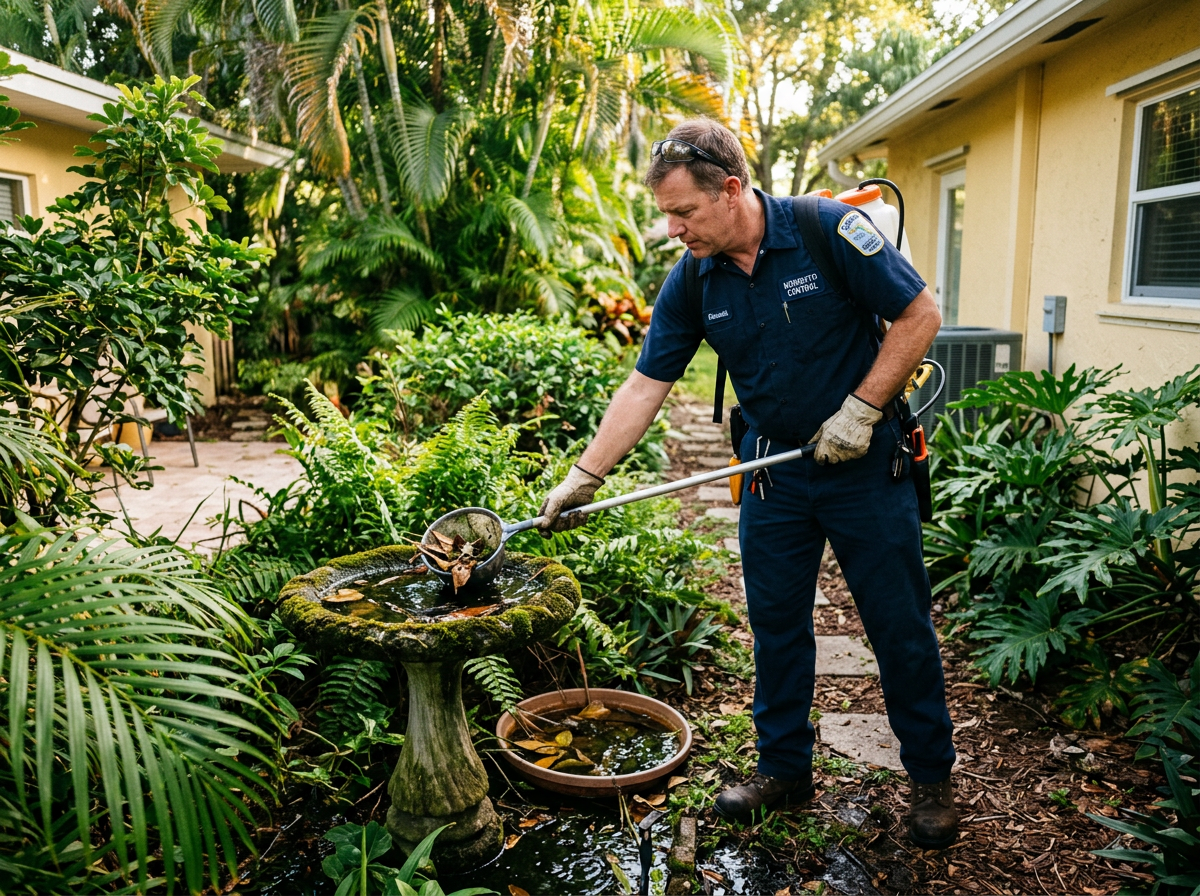
Branford properties often feature older construction and deep porches set among river floodplain vegetation. Crews time visits around seasonal water levels in the Suwannee and nearby sloughs to reach shaded resting spots effectively.
Access follows US-27 and FL-247 from the Brooksville base, allowing consistent coverage through hot summers when river-adjacent breeding peaks.
Here's how our standing water and breeding site reduction work runs in Branford — the same standards we hold across Florida, delivered by the crew that covers Suwannee County.
Standing Water and Breeding Site Reduction Services We Offer in Branford
✓Bromeliad Flushing
Water is flushed from the leaf axils of bromeliads where Aedes larvae develop, then the plants are monitored on return visits.
✓Gutter and Downspout Clearing
Debris is removed so rainwater flows freely instead of pooling in sagging sections that breed mosquitoes within metres of living areas.
✓Container and Saucer Audit
Every plant saucer, bucket, toy and trash can lid on the property is inspected, emptied or altered to prevent water collection.
✓Tarp and Boat Cover Check
Covers are lifted, dried and repositioned or replaced with breathable materials so standing water does not collect after storms.
✓Larvicide for Water That Cannot Be Drained
Approved larvicide is applied to permanent water features such as rain barrels and ornamental ponds that cannot be emptied.
✓Property Breeding-Site Survey
A full lot walk identifies every container and low spot that holds water long enough for mosquito development.
In Brooksville the daily cycle begins with container breeders that need only a bottle cap of water. Bromeliads, plant saucers, clogged gutters, rain barrels and boat covers sitting within a few metres of the house refill every afternoon when storms pass through. Technicians walk the entire lot, tipping, flushing or removing each container rather than spraying open lawn where adults do not rest.
Work focuses on the shaded, protected spots where larvae actually develop. Gutters are cleared of debris so water flows to downspouts; tarps and covers are lifted and dried; saucers under potted plants are emptied or drilled for drainage. When water cannot be removed, a targeted larvicide is placed in the remaining pockets. The same inspection catches the small pockets behind air-conditioner drip lines and in old wheelbarrows left behind sheds.
How It Works in Branford
- 1
Lot Walk and Mapping
Technician walks every accessible area noting containers, vegetation and drainage issues on a site map.
- 2
Source Elimination
Containers are emptied, tipped or removed; gutters are cleared; tarps are adjusted on the same visit.
- 3
Targeted Larvicide Placement
Water that cannot be removed receives a label-approved larvicide in the exact pockets where larvae are present.
- 4
Follow-Up Inspection
Return visit checks for new accumulations created by recent storms and updates the treatment list.
Serving All of Branford
We regularly handle standing water and breeding site reduction jobs near:
- 📍Suwannee River
- 📍US-27 corridor
- 📍FL-247
- 📍Branford river access points
- 📍Downtown Branford riverfront
Standing Water and Breeding Site Reduction Pricing in Branford
Cost depends on lot size, number of containers and how many sites require repeated attention; call for an on-site assessment.
Want the full picture of this service? See our Standing Water and Breeding Site Reduction page, or everything we do in Branford, FL.